The Union government has called for the creation of integrated value chains in the sheep and goat sector, stressing that the segment holds significant untapped potential for rural livelihoods, much like dairy and poultry.
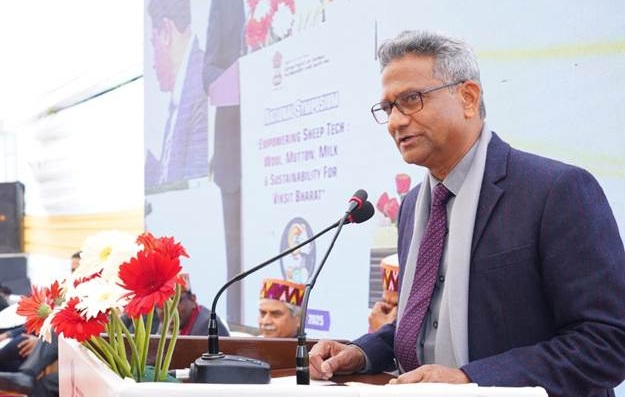
The message came from the Department of Animal Husbandry and Dairying (DAHD) at a national sheep symposium held on December 22 at the ICAR–Central Sheep and Wool Research Institute (CSWRI) in Avikanagar. The event brought together policymakers, scientists, state officials, industry representatives, start-ups, non-profits and farmers from across the country.
Addressing the gathering, DAHD Secretary Naresh Pal Gangwar said that while dairy and poultry have benefited from strong cooperative and private-sector driven value chains, the sheep and goat sector continues to remain fragmented. He pointed out that India contributes nearly 25 per cent of global milk production and ranks second in egg production, largely due to organised market structures that ensure better prices for farmers.
“In contrast, sheep and goats — often called the ‘ATM of the poor’ — remain critical for small and marginal farmers, but their economic potential is yet to be fully realised,” Gangwar said. He stressed the need for research-led interventions and better last-mile delivery so that scientific advances translate into income gains at the farm level.
The symposium highlighted how integrated value chains — covering breeding, veterinary care, feed, processing and market access — could help stabilise incomes and improve productivity in meat and wool. Gangwar also flagged the importance of disease control, particularly the rollout of Peste des Petits Ruminants (PPR) vaccination programmes, given both export opportunities and the widening gap between domestic demand and supply.
Earlier, Dr Arun Kumar Tomar, Director of ICAR-CSWRI, set the context by outlining the current status of the country’s sheep, mutton and wool sectors, noting challenges such as declining demand for wool due to synthetic alternatives and uneven access to improved breeds.
Dr Muthukumarasamy B., Joint Secretary at DAHD, said the Centre is placing special emphasis on breed improvement under the National Livestock Mission (NLM). He noted that the response to the Entrepreneurship Development Programme under NLM has been strong, with capital subsidies of up to 50 per cent — capped at ₹50 lakh — available for sheep and goat projects with a capacity of 500 animals.
He added that under the Animal Husbandry Infrastructure Development Fund, the government is offering a three per cent interest subvention for activities ranging from waste-to-wealth initiatives and vaccine production to primary wool processing units. However, he underlined that public funding alone would not be enough and called for greater private-sector participation, especially in training farmers and first-generation entrepreneurs.
Animal Husbandry Commissioner Praveen Malik echoed the need for policies that recognise regional resources and production systems, rather than adopting a one-size-fits-all approach. He also emphasised the expansion of artificial insemination services and mobile veterinary vans to improve genetic quality and animal health in remote areas.
The event also saw participation from institutions such as the National Dairy Development Board, Central Wool Development Board, ICAR-National Meat Research Institute and CCS-National Institute of Agricultural Marketing, along with state animal husbandry departments and farmer groups.
Technical sessions during the day focused on wool, mutton, milk, genetic resources and entrepreneurship, with farmers and experts openly discussing bottlenecks ranging from market access and processing infrastructure to skill gaps.
A newsletter titled CSWRI at a Glance was released during the symposium.
As policymakers look to replicate the success of dairy-led rural transformation, the discussions underscored a clear message: without integrated value chains and stronger linkages between research, markets and farmers, the sheep and goat sector will continue to fall short of its potential — despite being a lifeline for millions in rural India.


 animal husbandry policy India
animal husbandry value chains
DAHD sheep symposium
goat farming India
integrated value chains livestock
National Livestock Mission
rural livelihoods livestock
sheep and goat sector India
sheep farming India
wool and mutton sector India
animal husbandry policy India
animal husbandry value chains
DAHD sheep symposium
goat farming India
integrated value chains livestock
National Livestock Mission
rural livelihoods livestock
sheep and goat sector India
sheep farming India
wool and mutton sector India