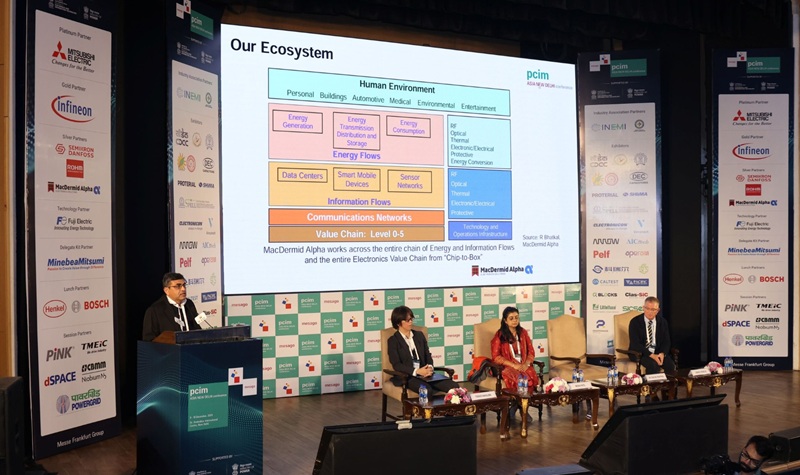
The PCIM Asia New Delhi Conference, a global platform for the power electronics industry, made its debut in India this week, drawing strong participation from industry, academia and government. The two-day conference brought together over 550 delegates, with nearly 90 per cent coming from academic and research institutions and the rest representing policymakers and government bodies.
The event focused on the future of high-efficiency power electronics and its role in supporting India’s energy transition. More than 100 speakers and panellists took part across 15 conference sessions, along with leadership roundtables, tutorial sessions and an R&D and innovation showcase featuring exhibitors from across the world.
India’s expanding power infrastructure formed a key backdrop to the discussions. The country currently operates the world’s largest synchronous grid, often described as “one nation, one grid, one frequency,” with the national transmission network stretching close to 500,000 circuit kilometres.
Addressing the conference, chief guest Dr D Saibaba, Joint Secretary (Transmission) at the Ministry of Power, underlined the importance of high-efficiency power electronics in modernising India’s transmission systems and smart grids. He said power electronics had become central as India works towards integrating 500 GW of non-fossil energy capacity by 2030 and building high-capacity transmission corridors for renewable energy zones. He also pointed to plans to develop high-voltage direct current (HVDC) systems domestically, reducing dependence on imports, with support from the Ministry of Electronics and Information Technology.
Guest of honour Sunita Verma, Group Coordinator for R&D and Joint Secretary at MeitY, highlighted the government’s long-standing support for research in power electronics. She noted growing opportunities under India’s semiconductor mission, including potential fabrication facilities for silicon carbide. According to her, policy support and rising domestic and global demand could position India as a significant player in power electronics manufacturing.
Sustainability and decarbonisation were recurring themes across keynote sessions. Dr Gourab Majumdar, IEEE Fellow and Senior Fellow at Mitsubishi Electric Corporation, spoke on the role of advanced power semiconductor technologies in achieving carbon neutrality. He said semiconductors enable efficiency across the energy value chain, from renewable generation and long-distance transmission to electrification at the consumption stage.
Dr Baghaie Yazdi Mehrdad, Vice President at Infineon Technologies, focused on how power electronics will shape future electricity grids. He pointed to applications in DC microgrids, electric mobility, automated factories and AI data centres, and highlighted the emergence of solid-state transformers as a way to modernise grid infrastructure while reducing size and improving efficiency.
International collaboration also featured prominently in discussions. Prof Dr Leo Lorenz, President of the European Centre for Power Electronics, said India’s power electronics market is expected to grow from USD 2.8 billion to USD 4.5 billion by 2032. He noted that recent investments in semiconductors, combined with strong academic and industry collaboration, give India a solid foundation to emerge as a global player, while also addressing environmental impact.
Industry representatives echoed similar views. Puneet Tyagi, Chief General Manager at Power Grid Corporation of India, said bringing semiconductor manufacturers and industry stakeholders together was particularly relevant for the transmission ecosystem. Steffen Beushausen of Bosch described the conference as a valuable forum for exchange between companies and academia, especially in understanding emerging opportunities in the Indian market.
Organised by Mesago Messe Frankfurt GmbH and Messe Frankfurt Trade Fairs India, the inaugural PCIM Asia New Delhi Conference marked a significant step for the power electronics ecosystem in India, signalling growing momentum around grid modernisation, semiconductor capability and the country’s broader clean energy goals.


 Grid Modernisation
PCIM Asia Conference
Power Electronics
Grid Modernisation
PCIM Asia Conference
Power Electronics